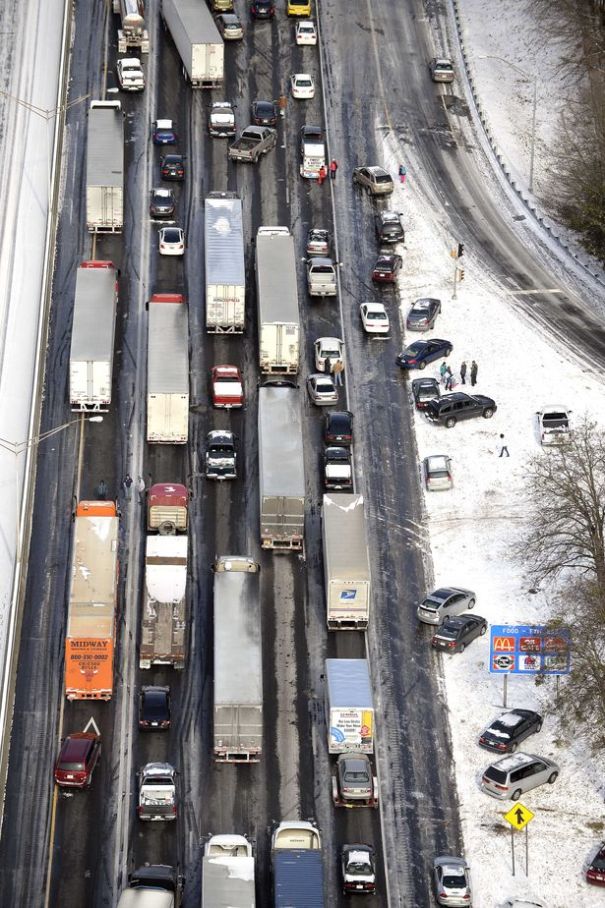
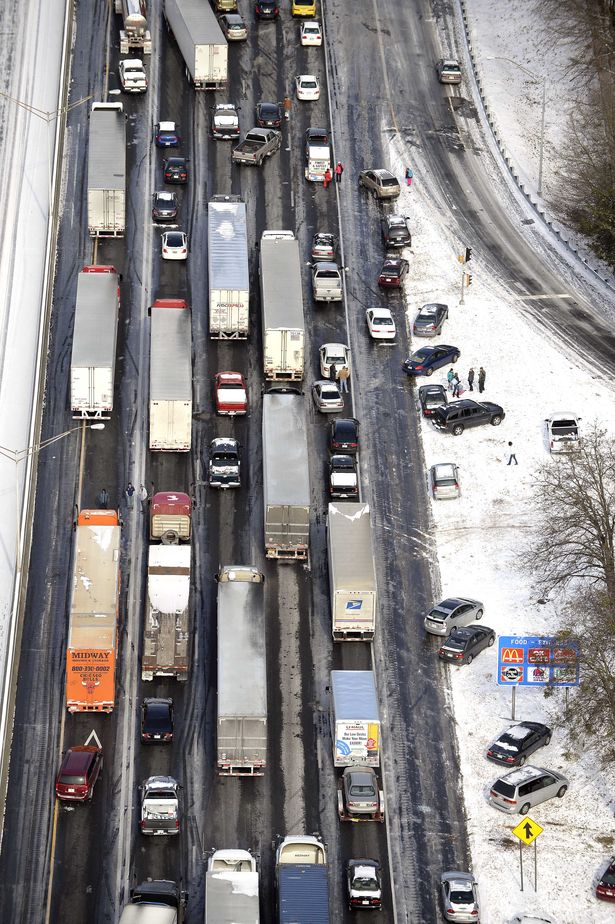
Courtesy of the AJC. Motorists chat outside their vehicles after spending the night on the highway @ I-75 and Moores Mill Road, Atlanta, Wednesday, January 29, 2014.
http://media.cmgdigital.com/shared/lt/lt_cache/thumbnail/615/img/photos/2014/01/29/41/8b/Winter_Weather_Georgia_.JPE1_1.JPG
It’s the Wednesday after “Snowpocalypse 2014” in Atlanta, and someone posted the question on the “SnowedOutAtlanta” Facebook page, “do you think we should put an emergency kit in our cars?”
I sincerely hope you do that, and more!
Here are three things you can do today – in five minutes or less – that could save your life tomorrow – or perhaps this week, when additional extreme weather (for us) is forecast:
1) Pack a “GO” Bag and put it in the trunk/hatch of your vehicle. The purpose of a GO Bag is to enable you to Get Out (of trouble). Parked on a gridlocked interstate for 12-to-24+ hours with temps dropping well below freezing is definitely one type of what I call trouble. At a minimum, your GO bag for mid-October through mid-April in the southeastern US should include:
- a backpack for easy storage and transport
- a pair of hiking boots or walking shoes (preferably broken-in and waterproof)
- a pair of extreme cold weather (XCW) socks
- a pair of sweatpants that fits over whatever you usually wear (suitpants, jeans, whatever) to add that extra layer of wind-breaking, cold-busting comfort
- a sweatshirt/fleece jacket that fits over your blouse/shirt – which, frankly, many of you ladies would really benefit from having with you pretty much at all times, given your proclivity for being cold indoors even in the summer (HELLO!)
- your standard cold-weather gear: a 3-in-1 or 4-in-1 parka with liner, a pair of XCW gloves, a ski cap/face mask and scarf…if you don’t know what to wear outdoors in the cold, ask a hunter, snow skier or biker – it’s what they do!
- a quart or more of potable water
- a few energy/protein bars and snacks
- at least 3 days’ medications – pain relievers, insulin, heart meds – whatever you need.
Note: don’t leave your GO bag in the trunk; rather, take it with you when you’re taking a road trip in someone else’s vehicle, and take it into your home/hotel room/etc. overnight so the liquids and electronics therein don’t freeze and start acting funny…Cold temps drain batteries, cause tires to lose air pressure, and freeze moisture (water expands when it turns to ice).
Mind you, this is supplemental to both a vehicle emergency kit and your EDC kit. Oh, yeah – if you have kids, spouse, etc. in the car, have one for each! Those of you who spent the night on 285 – imagine: if you had these things, you could’ve walked to shelter nearby…
The vehicle emergency kit should remain in your car year-round. Do consider taking it with you on a road trip in a rental car or someone else’s car if they’re not prepped like you! Change certain items out every 3-to-6 months – e.g., store the snow chains in the garage come late Spring, check the charge on your fire extinguisher, and refresh your extra water (which, in addition to emergency hydration, can be used to refill your radiator after you’ve used the duct tape in your kit to repair that unexpected pinhole leak in the hose). Check http://tinyurl.com/vehemerkit for more of what to include.
Your “EDC”, or Every Day Carry, kit consist of items that should be on your person or within reach pretty much all day every day. Keys, tactical flashlight, pocketknife, emergency cash & credit cards, mobile phone with car and home chargers and juice pack, and a business card with important phone numbers/info written on the blank back so when your phone’s battery dies – you don’t have to follow suit!
What else would you put in your EDC kit? Your GO Bag? Your vehicle emergency kit? Do it now, before you NEED it and don’t have it! And share your thoughts in the comments below!
2) Check your tires for proper inflation and serviceable condition. Tires lose pressure in cold weather, leading to uneven wear and other potential dangers. A tire pressure gauge can be had for as little as $2 at the local auto parts chain, and having your own can be a life-saver rather than depending on the accuracy and availability of one that may (or may not!) be built-into the air hose at a gas station, or that’s part of your vehicle’s electronics package.
Check your tires when they’re cold – in other words, when they’ve been sitting not driven for an hour or more. [The vehicle manufacturer’s recommended cold tire pressure(s) should be listed in the owner’s manual and on a sticker on the inside of the driver’s door frame. The tire manufacturer also lists in fine print on the tire’s sidewall the maximum cold psi.] Write down the cold pressure, then drive to the service station (if underinflated) and check again – the air pressure increases as the air inside the tire heats up from the friction of tread on road, sometimes 2, 3, 4 or even 5+ psi (pounds per square inch). If the carmaker recommends 32 psi, and your cold reading was 27, you should add 5 psi when you get to the air hose. E.g., if your “warm” reading is 30 after driving a mile or 10 to the air hose, fill it to 35 and you should be close to 32 cold.
Regarding serviceable condition, I just googled “youtube check my tires” and watched a few videos for you – in my opinion, this one is the most comprehensive and helpful of the first page of results, so invest 3 minutes in some additional tire tips: http://www.youtube.com/watch?v=ck9rmeG3lgE. Driving on worn-out or otherwise damaged tires can lead to inconvenience at best – and possibly catastrophe – for you, your passengers, and even potentially thousands of drivers who could get stuck behind your broken-down vehicle.
PLEASE! Check your tires today. And once a month, while you’re at the gas station filling up.
3) Check the weather forecast! There’s an app for that! And decide for yourself whether meteorologists, government officials, employers, journalists or others have a track record worth trusting. [Q: who’s going to be stuck in gridlock, running out of gas, spending the night in their car, kids left at school, etc.? A: The person responsible for making the right decision for themselves, their family and their workplace.]
Invest a few minutes today into YOUR comfort, safety and security tomorrow!
If you like this post, please subscribe, link, tweet, ‘like’ on facebook, and spread the word! You might just save a life.
#snowmageddon, #snowpocalypse, #snowjam, #gridlock, #survival
Feel free to comment on your “Snowmageddon” story below!




 MartellSells.com
